
Glynn County Arrest Records and Court Charges
Glynn County arrest records begin on the law-enforcement side. A jail or booking record may show the person arrested, booking date, arresting agency, initial charges, bond, warrant number, court reference, and release status when that information is public. The Glynn County Sheriff's Office is the primary local source for jail custody, active warrant information, civil process, sex offender links, and sheriff-controlled records. Those records are useful, but they are not the same as the court charge record.
Court charges after arrest begin when the prosecutor or court process turns an arrest allegation into a formal case entry. The Brunswick Judicial Circuit District Attorney handles felony prosecution and many serious criminal charging decisions in Glynn County. Arresting officers may lodge initial charges, but prosecutors decide what charges are filed, amended, reduced, dismissed, or pursued. The full case file and outcome are handled in Glynn County criminal court records, while booking custody details belong with jail and sheriff sources.
Find Glynn County Arrest Records and Charges
Start with the record type. For jail custody and booking context, use the official Glynn County Sheriff's channels, including the sheriff site and inmate roster where active custody records are available. For filed court charges and charge status, search court records through re:SearchGA if the case is participating and public, then contact the court that owns the case if the online result is missing, incomplete, restricted, or uncertified. Felonies generally route to Superior Court, while misdemeanors may be in State Court, Municipal Court, or another lower court.
- Check whether the question is about current custody, a past booking, a warrant, or a filed court charge.
- Use sheriff records for booking context and the court search path for formal charges after arrest.
- Search by defendant name, case number, booking number, warrant number, or approximate arrest date when the system supports it.
- Read each charge separately, including charge level, status, disposition, bond, and related court.
- Contact the sheriff, Clerk of Superior Court, State Court, Magistrate Court, Municipal Court, or prosecutor when online data conflicts.
The Glynn County Sheriff's Office standalone site is one official sheriff source named in the research.

It supports the arrest-record side of the inquiry, while formal charge status must still be checked against the court or prosecutor record.
Charges Filed After a Glynn County Arrest
After an arrest, the first public facts may come from jail or warrant records. The court charge record develops when a complaint, accusation, indictment, or other charging document is filed or entered in the appropriate court. Georgia terminology in the research identifies an accusation as a prosecutor's formal misdemeanor charging document and an indictment as a grand-jury charging document for felony prosecution. A complaint or warrant-linked filing can also appear early in the case path.
| Complaint / warrant filing | Accusation | Indictment | |
|---|---|---|---|
| Common source | Law enforcement or court warrant process. | Prosecutor. | Grand jury. |
| Common use | Initial arrest, warrant, first appearance, or probable-cause context. | Formal misdemeanor prosecution where used. | Felony prosecution in Superior Court. |
| What it shows | Arrest charge, offense description, warrant number, bond, or hearing path. | Filed charge, count, offense description, and prosecutor action. | Grand-jury charge, count, offense description, and felony case filing. |
| Where to confirm | Sheriff, Magistrate Court, or the court tied to the first appearance. | State Court, Municipal Court, or the prosecutor/court handling the misdemeanor. | Superior Court and the Clerk of Superior Court. |
Glynn County Charge Status Terms
A charge can change between arrest and final disposition. One arrest can produce several charges, and each charge may have a different path. Bond can change after hearings, a first-appearance entry can be followed by prosecutor review, and a felony may move from Magistrate Court context to Superior Court. Always read the current status and final disposition for each count rather than treating the initial arrest charge as the final court result.
| Status | What It Means |
|---|---|
| Pending | The charge is still active or unresolved in the court record. |
| Amended | The prosecutor or court filing changed the charge description, count, statute, or level. |
| Reduced | The charge was lowered to a less serious offense or count through prosecution or plea process. |
| Dismissed | The court record shows the charge was dismissed and did not result in conviction for that count. |
| Nolle prosequi | The prosecutor dismissed the charge, often shown as a docket or disposition entry. |
| Disposed | The charge has a recorded outcome, which may be conviction, dismissal, plea, acquittal, or another final status. |
Charge vs Conviction in Glynn County
Being charged after arrest is not the same as being convicted. A Glynn County arrest record may show an initial charge before the prosecutor has made a final filing decision. A court record may then show amended charges, dismissed counts, a plea, a trial result, or a sentence. A conviction should be tied to the final disposition and sentence, not just the booking charge or warrant line.
| Charge | Conviction | |
|---|---|---|
| Stage | Appears after arrest, warrant, accusation, indictment, or prosecutor filing. | Appears after plea, verdict, or court finding. |
| Meaning | An allegation or filed count. | A final finding of criminal responsibility for that count. |
| Can change | May be added, amended, reduced, dismissed, or nolle prossed. | May be affected by appeal, sentence modification, or later court action. |
| Search caution | Do not treat arrest charges as proof of guilt. | Verify the disposition, sentence, and case number with the court. |
Restricted Glynn County Arrest Records
Georgia record restriction may limit public access to eligible criminal-history information. Glynn County restriction questions should start by separating the arrest from the court disposition. If the case was dismissed, not prosecuted, or otherwise eligible under O.C.G.A. § 35-3-37, a person may be able to pursue restriction through law enforcement, the prosecutor, or the court process depending on the posture of the case. Conviction eligibility is narrower.
| Sealed | Restricted | |
|---|---|---|
| Visibility | Hidden or limited by court order. | Public criminal-history dissemination is limited when granted. |
| Records affected | May affect court filings, docket access, or case documents. | May affect eligible arrest or criminal-history information. |
| Who may still access | Courts, law enforcement, prosecutors, and authorized agencies may retain access. | Courts, law enforcement, prosecutors, and certain agencies may still access restricted information. |
| Facts needed | Case number, charge, court, and sealing order details. | Arresting agency, case number, charge, arrest date, prosecutor, and final disposition. |
Charge Codes and Severity Levels
Charge codes connect the allegation to a criminal statute or offense description when the roster, warrant, docket, or court record provides that detail. In Glynn County, felony charges generally move through Superior Court, while misdemeanors may be in State Court, Municipal Court, or another lower court depending on the charge. A charge row can also include bond, warrant number, arresting agency, next court, or disposition, but those fields differ by system.
Serious traffic offenses, DUI, felony fleeing, vehicular homicide, and related criminal charges can cross from traffic context into criminal court records. A traffic citation may remain in State Court or Municipal Court, while a felony charge can begin with arrest and first appearance before becoming a Superior Court case. The level of the charge controls where it is filed and how the court record should be read.
Statewide and Federal Charge Context
State and federal sources can add context, but they do not replace Glynn County court charge records. Georgia DOC offender query covers sentenced state prisoners, not current county jail custody or a pending local charge. VINELink is for custody notification. Federal criminal cases arising in coastal Georgia belong to the U.S. District Court for the Southern District of Georgia and are searched through federal systems, not the Glynn County Clerk of Superior Court.
The U.S. Attorney's Office for the Southern District of Georgia is relevant only when charges are federal rather than state or local.
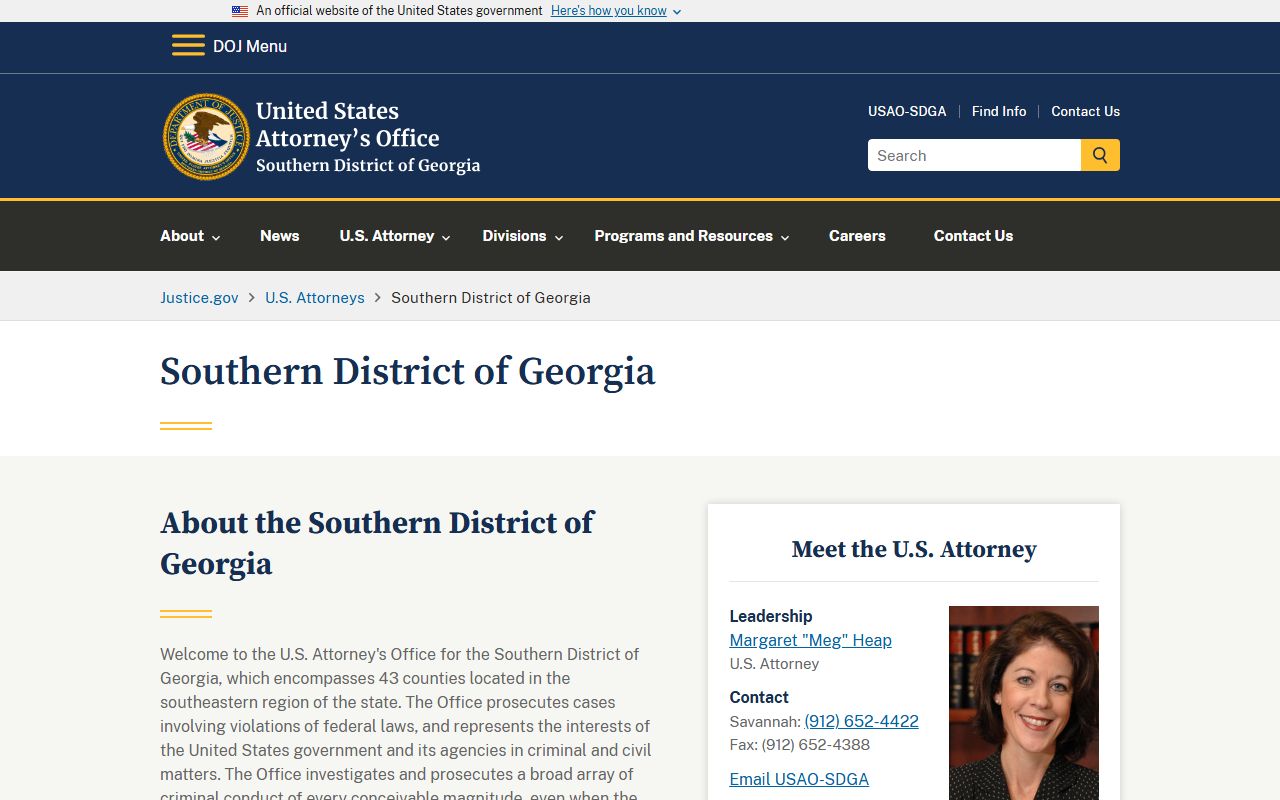
A federal indictment will not be certified by a Glynn County court clerk, even if the person lives in Glynn County or was arrested locally.
Restricted Charge Records in Glynn County
Some charge records are not public or are only partly visible. Juvenile charges are not treated like adult public records under Georgia law. Sealed criminal cases, restricted criminal histories, adoption-related matters, mental-health details, full dates of birth, Social Security numbers, bank account information, protected addresses, victim safety details, and medical facts may be withheld or redacted. Search warrants and sealed warrants may also be unavailable until executed or unsealed.
When an online arrest or charge result conflicts with a court disposition, verify with the official custodian. The sheriff may have booking or warrant facts, the prosecutor may know whether a charge was filed or dismissed, and the court record shows the filed document, docket status, disposition, and sentence. The research did not locate one universal Glynn County fee or form for every charge-record restriction, so current steps must be confirmed with the proper office.
Note: Initial arrest charges can change quickly after prosecutor review, bond hearings, first appearance, or formal court filing.